


Fieldnotes
The 2026 Nobel Prize in Physiology or Medicine was awarded to Karl Deisseroth, Peter Hegemann and Georg Nagel “for their discoveries concerning light-gated ion channels and optogenetics”. Their work enables researchers to investigate how nerve cells shape memories, emotions and behaviour, and to test causal relationships between neural activity and behaviour.
Karl Deisseroth transformed this discovery into a tool for neuroscience. By introducing the gene for channelrhodopsin into nerve cells, he enabled researchers to activate selected neurons with pulses of light, while other light-sensitive proteins can inhibit neuronal activity. Delivered through fine optical fibres, these switches operate with millisecond precision, allowing scientists to examine neural circuits involved in movement, memory, depression, Parkinson’s disease, addiction and anxiety. Optogenetics brings together molecular biology, genetics, optics and behavioural neuroscience, enabling the brain to be studied from molecular processes to behaviour.
Read further in the Press release Nobel Prize for Physiology or Medicine 2026.
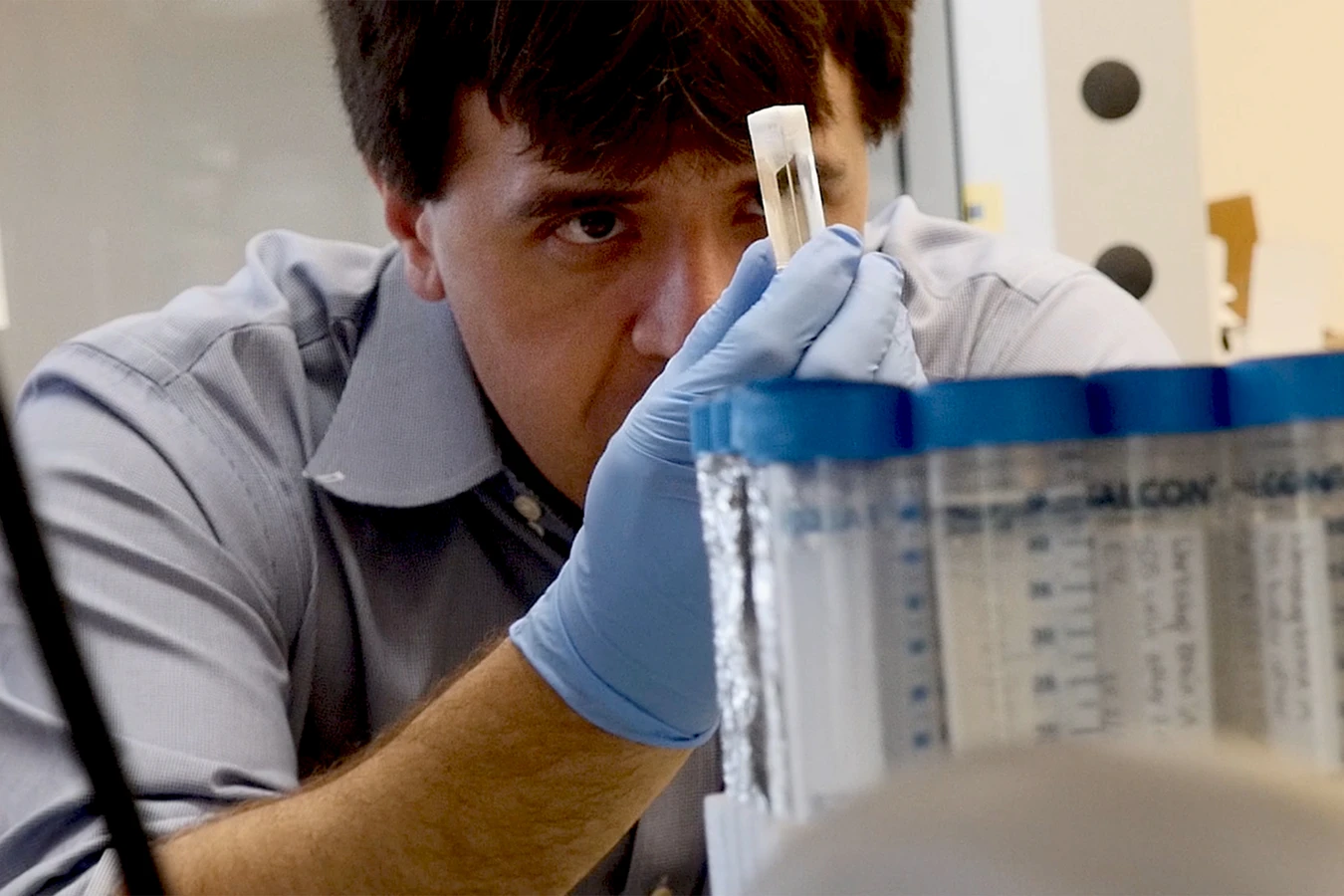
Film still from the film portrait about Karl Deisseroth.
Imagining Science/ HSLU, 2017
In 2017, the NOMIS Foundation commissioned Imagining Science to produce a film portrait of Karl Deisseroth, following his receipt of the 2017 NOMIS Distinguished Scientist Award. The film was created by students participating in the Imagining Science Film Masterclass.
In 2022, Svante Pääbo, also a laureate of the 2017 NOMIS Distinguished Scientist Award, received the Nobel Prize in Physiology or Medicine. View the film portrait of Swante Pääbo made by Imagining Science.
View further Nomis Award film portraits by Imagining Science on imaginingscience.eu.